The Senate is infamous for being an old boys' club, with success dependent on tenure, gender, and willingness to exert one's power. The 83rd Legislature was no different from the surface, but we decided to dig a little deeper into the actual lawmaking - who authored what bills, and how many passed? The dashboard above gives some insight into a small window of the process. Overall, the Senate is less prone to turnover than the House. A legislative staffer in Senator Ellis' office, Keith Salas, agreed to give us some background. "The Senate is definitely the upper chamber, in every sense of the word. Lots of legislators graduate from the House to the Senate, and when Senators are elected, they generally stick around for a number of terms. Tenure definitely matters - Ellis is one of the longest-standing Senators, and he definitely commands a fair amount of influence." But does that tenure matter?
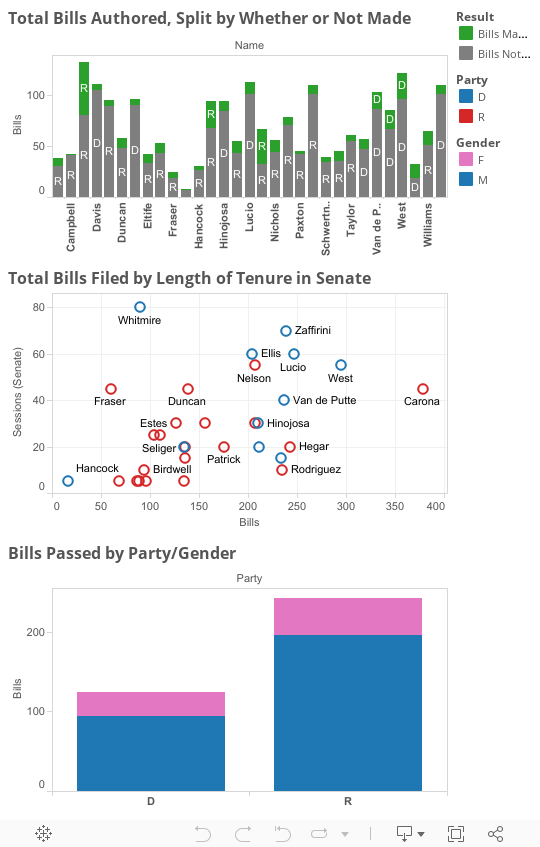
Evidently so. A quick look at the graph labeled “Total Bills Filed by Length of Tenure in Senate” shows the number of bills authored by each lawmaker as well as the number of sessions that lawmaker has served. Though not completely linear, a senator’s tenure does seem to be linked to his/her productivity in terms of number of bills produced in this session. Party doesn’t seem to affect the sheer number of bills authored too greatly. After all, according to Salas, “many Democrats are among the longest-serving members, and they produce a similar number of bills to many Republicans.”
Whether or not those bills are successful, however, does seem to have something to do with party. The bar graph depicts the total number of bills authored by each Senator, with the number that eventually made it into law and the number that didn’t. A close examination starts to reveal that Republicans, on the whole, had a higher percentage of their bills pass per member than Democrats, though some exceptions do exist (take a look at Whitmire’s record - he authored few bills, but a large percentage of those bills eventually made it into the law books). You may also notice a concentration of power in the hands of a few Republicans - Carona, Hegar, and Nelson all stand out.
Lastly, what effect might the gender of the author have on a given bill’s success or failure? Probably less than you think. The last graph sheds some insight on bills passed by party and gender – the party breakdown roughly approximates the 1/3:2/3 split you would expect, given that about 1/3 of the Senators are Democrats. The number of bills passed by female Senators, too, roughly approximates their own percentage in the Legislature – with 7 women, we would expect somewhere in the range of 23% of the bills passed to be authored by women, and the numbers fall just shy of that.
So what does this all mean? Ellis' staffer admits that the Senate "has a long way to go" on equal representation issues, partisan politics, and "maybe even tenure." But tenure is a touchy subject - "if everyone were a freshman, there would be no historical perspective," Salas mentioned. "We'd never get anything done."
